 Home
HomeHome / SWITCH 2026: What Singapore's Flagship Innovation Week Means for Asia's Tech Economy
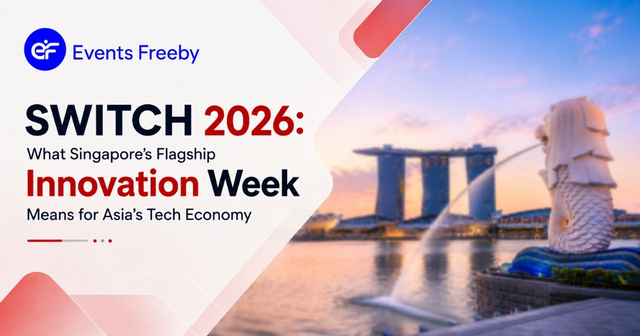
SWITCH 2026: What Singapore's Flagship Innovation Week Means for Asia's Tech Economy
Posted By: Eventsfreeby Blogger
Last Update : Jul 02, 2026



 Copied!
TL;DR
What is SWITCH 2026? The Singapore Week of Innovation and Technology (SWITCH) is Asia's most influential deep tech and innovation festival, organised by Enterprise Singapore and supported by the National Research Foundation. SWITCH 2026 takes place on October 27–29, 2026 at the Sands Expo & Convention Centre, Marina Bay Sands, Singapore.
What are the key numbers? 25,000+ expected attendees, 400+ startups and exhibitors, 30+ global country pavilions, participants from over 100 markets worldwide.
What is SLINGSHOT 2026? SLINGSHOT is Asia's premier deep tech startup pitching competition, now in its landmark 10th edition. Applications were open until June 30, 2026. The competition features over S$2 million in Startup SG grant prizes across five domains: Advanced Computing & Intelligence, Advanced Manufacturing & Industrial Systems, Digital Technologies & Security, Environment/Energy/Sustainability, and Health & Biomedical.
Why does SWITCH matter for Asia's tech economy? SWITCH is a direct policy instrument of Singapore's RIE 2030 (Research, Innovation and Enterprise) framework, which commits SGD 37 billion in public investment across five years from April 2026 roughly 1% of GDP annually to position Singapore as the leading deep tech hub for the Global-Asia ecosystem. Every major deal, partnership, and cross-border pilot that begins at SWITCH eventually ripples across ASEAN and beyond.
What does this mean for B2B exhibitors? SWITCH has evolved from a startup showcase into a full-scale B2B procurement and partnership environment, where corporations, government agencies, and VCs converge specifically to identify partners, sign pilots, and deploy capital. Companies exhibiting here are not just gaining visibility they are entering the most curated innovation marketplace in Asia.
How can Events Freeby help? Events Freeby manages end-to-end exhibition participation for B2B technology companies at SWITCH Singapore and major tech trade shows across Asia and the Middle East from booth design and freight logistics to pre-event outreach and post-show lead nurture.
Introduction: October in Singapore Is a Different Kind of Busy
If you've spent any time in Singapore's innovation circles, you already know that October is its own season. The city shifts into a higher gear: delegate badges appear at hotel lobbies, Marina Bay Sands fills with a particular mix of hoodie-wearing founders and suited procurement directors, and the conversation in every coffee meeting pivots to the same few questions who's exhibiting, who's pitching, who's investing, and what's actually worth seeing on the floor.
SWITCH is why.
The Singapore Week of Innovation and Technology has, over the course of eleven years, quietly become one of the most strategically significant innovation events in Asia. Not the loudest. Not the most glamorous. But probably the one where the deals that actually close, the partnerships that actually happen, and the startups that actually scale tend to originate.
SWITCH 2026 runs October 27–29 at the Sands Expo & Convention Centre, Marina Bay Sands, and it arrives at a genuinely important moment. Singapore has just committed SGD 37 billion to its RIE 2030 research and innovation plan. The country's AI ambitions are accelerating AI is expected to contribute approximately USD 29.6 billion to Singapore's economy by 2030, representing about 30% of GDP. Quantum computing is moving from research labs to commercial deployment. And Asia's broader technology economy is restructuring itself around deep tech capability in ways that make Singapore's position as a neutral hub more valuable than it has ever been.
This blog breaks down everything that matters about SWITCH 2026: what it is, why it has grown into what it is today, the sectors and stages that define the 2026 programme, the role of SLINGSHOT in Asia's startup ecosystem, and what the whole event means for companies and innovators trying to navigate Asia's increasingly complex tech economy. Whether you are exhibiting, attending, pitching, or investing, this is the context you need before you step through those doors.
Part 1: What SWITCH Actually Is and Why It's Not Just Another Tech Conference
The Short Version
The Singapore Week of Innovation and Technology brings together leaders, entrepreneurs, creators, accelerators, and investors from the Global-Asia innovation ecosystem. That sentence is on the SWITCH website and it is accurate, but it undersells what the event has become in practice.
SWITCH started as a platform to address a specific problem: how do you accelerate the translation of publicly funded R&D into commercially viable products and companies? Singapore invests heavily in research institutions, university labs, and public R&D programmes. The challenge has always been the gap between scientific discovery and market application. SWITCH was designed to bridge that gap and over eleven editions, it has gotten very good at doing exactly that.
The Policy Context
SWITCH is not a private-sector event that happens to have government support. It is the other way around: it is an Enterprise Singapore initiative that happens to look and feel like a commercial tech festival. That distinction matters enormously for understanding what happens there.
Enterprise Singapore the government agency championing enterprise development organised SWITCH from the beginning. The National Research Foundation (NRF) under the Prime Minister's Office is a core supporting institution. This means SWITCH fits within Singapore's formal Research, Innovation and Enterprise (RIE) framework, which now runs under its eighth iteration, RIE 2030, committing SGD 37 billion over five years starting April 2026 a 32% increase from the previous five-year plan.
What that means practically: the companies, technologies, and partnerships surfaced at SWITCH are not just interesting from a commercial standpoint. They are explicitly aligned with Singapore's national priorities in advanced manufacturing, AI and compute, quantum technology, health and biomedical sciences, and sustainability. When a startup wins SLINGSHOT or signs a corporate pilot at SWITCH, it is often entering a procurement and validation process that has institutional backing at the highest level.
For international companies, that context is commercially valuable. Singapore's government procurement and regulatory environment is one of the most transparent and navigable in Asia, and SWITCH is one of the few venues where public-private partnerships form in a genuinely structured way.
How SWITCH Has Grown Over a Decade
The numbers tell a clear story. When SLINGSHOT (the startup competition within SWITCH) launched in 2017, it received 1,000 applications from 80 markets. By SWITCH 2025, SLINGSHOT attracted over 6,800 applications from more than 150 markets. SWITCH 2024 drew 20,000 attendees from 100+ global markets. SWITCH 2026 is targeting 25,000+ attendees, 400+ exhibitors, and 30+ global pavilions.
That is not just organic growth. It reflects a deliberate expansion of SWITCH from a regional Singapore-focused event into what it has genuinely become: a Global-Asia innovation festival where the quality of participant is, arguably, higher than any comparable event in the region.
Part 2: SWITCH 2026 The Structure, the Stages, and What's New
The Core Format
SWITCH 2026 is structured around four main components that serve distinctly different participant groups, and understanding which component is relevant to your goals is essential before you start planning your attendance.
The Main Stage (Plenary) is where the broadest strategic conversations happen keynotes from tech industry leaders, government representatives, and researchers speaking to the frontier questions in AI, robotics, quantum computing, and the future of Asia's innovation economy. This is where the context-setting happens, the kind of big-picture framing that gives the rest of the event its direction.
SWITCH Beyond is the deep tech-focused stage where domain-specific conversations go properly technical. In 2025, this stage ran four specialised tracks: Health & Biomedical Sciences, Quantum Tech, AI & Robotics, and AI for Materials. These were not panel discussions for general audiences they were masterclasses and technical sessions where researchers, founders, and corporate innovation teams worked through real implementation challenges. Expect a similar structure in 2026, likely with expanded coverage of embodied AI and advanced computing given Singapore's strengthening investments in these areas.
The Trade and Exhibition Floor is where the commercial action happens. Over 400 exhibitors and startups from 30+ country pavilions occupy the floor, making this the largest single-event concentration of deep tech companies in Asia. For B2B buyers corporate innovation teams, procurement officers, government agency representatives the floor is a curated marketplace unlike anything else in the region.
The Global Stage and Converge Stage round out the programme with more accessible content tracks covering entrepreneurship, fundraising, market expansion, and cross-border partnership formation. These stages are particularly relevant for companies navigating ASEAN market entry, where SWITCH's curated connections to Singapore's startup ecosystem including the Stage One platform that connects local and global tech startups are genuinely useful.
What Makes 2026 Different
SWITCH 2026 carries a particular significance because of where it lands on Singapore's policy timeline. The RIE 2030 framework kicked in from April 2026, meaning SWITCH 2026 is effectively the first major innovation gathering that operates under this new investment architecture. The priorities that RIE 2030 funds AI and compute, quantum technology, semiconductors, biomedical, and urban sustainability are the same priorities that will shape which exhibitors, which SLINGSHOT domains, and which investor conversations dominate the SWITCH 2026 floor.
Several specific developments make 2026 particularly relevant:
Quantinuum's Helios quantum computer, planned to be hosted in Singapore from 2026, represents a genuine milestone for quantum commercialisation in Asia. This is not a research demo it is a commercial-grade system that positions Singapore as one of a handful of global quantum hubs. Expect quantum computing to be a prominent conversation thread at SWITCH Beyond.
Google DeepMind opened an AI research lab in Singapore in 2025, reinforcing the city's position as an advanced AI research and talent hub. The presence of hyperscalers and frontier AI labs in Singapore means that SWITCH 2026 conversations about AI are grounded in actual deployment infrastructure, not just aspiration.
The Singapore Exchange–Nasdaq dual listing bridge, announced in early 2026, enables companies to tap liquidity and investors in both Asia and the United States from a single listing. For SWITCH exhibitors and SLINGSHOT participants with global ambitions, this changes the capital market calculus significantly.
Part 3: SLINGSHOT 2026 - The 10th Edition and Why It Matters Beyond the Competition
What SLINGSHOT Is
SLINGSHOT is Asia's flagship deep tech startup pitching competition, organised by Enterprise Singapore. SLINGSHOT 2026 marks its 10th edition, and it takes place as the centrepiece of SWITCH 2026 from October 27–29 at Marina Bay Sands.
The competition is not just a pitch contest. Over a decade, it has become one of the most important structured entry points into Singapore's innovation ecosystem a mechanism that connects deep tech startups with investors, corporate partners, and government grant agencies in a way that is difficult to replicate through any other channel.
The SLINGSHOT 2026 Prize Structure
The prize pool for SLINGSHOT 2026 exceeds S$2 million in Startup SG grant prizes, with additional perks that often matter more than the cash:
The Grand Winner receives the top grant prize, plus a rent-free workspace package at LaunchPad (JTC Corporation's flagship startup campus in Singapore), IP strategy support through IPOS International, and eligibility for EntrePass Singapore's entrepreneur working visa for foreign founders.
The Top 50 Global Startups receive a sponsored trip to Singapore for the Physical Immersion Programme (October 22–24, 2026, just before SWITCH) and entry into the SLINGSHOT Domain Finals. The value here is not primarily the travel subsidy it is the three days of curated investor meetings, corporate procurement conversations, and ecosystem introductions that the immersion programme provides.
The Five Competition Domains
SLINGSHOT 2026 accepts applications across five domains, and understanding them is important for any startup evaluating whether to apply or any corporate evaluating which SLINGSHOT startups to track:
Advanced Computing & Intelligence covers AI systems, machine learning applications, data infrastructure, and computational platforms. Given Singapore's investment in an AI compute park at one-north and the National AI Council's four sector missions (manufacturing, connectivity, finance, healthcare), this domain will likely attract the highest volume of competitive applications.
Advanced Manufacturing & Industrial Systems covers robotics, automation, precision manufacturing, Industry 4.0 applications, and supply chain technologies. Singapore's semiconductor ecosystem including partnerships with TSMC and GlobalFoundries gives this domain particular commercial traction for hardware-oriented startups.
Digital Technologies & Security covers cybersecurity, fintech, blockchain, digital identity, and enterprise software. Singapore's fintech ecosystem already exceeds 1,300 companies, and with a fintech transactional value of USD 42.8 billion projected to grow to USD 69.6 billion by 2030, this domain connects directly to one of the city's most commercially active sectors.
Environment, Energy & Sustainability covers climate tech, clean energy, sustainable materials, and urban sustainability solutions. The SGD 632 million Decarbonisation Grand Challenge and Singapore's Low-Carbon Technology Translational Testbed (LCT3) provide genuine commercial infrastructure for startups in this domain meaning SLINGSHOT winners in sustainability aren't just getting prize money, they are getting access to real testbed facilities.
Health & Biomedical covers diagnostics, digital health, precision medicine, biotech, and medical devices. A*STAR's translational platforms including the Diagnostics Development Hub, Experimental Drug Development Centre, and Nucleic Acid Therapeutics Initiative give health tech startups a commercialisation pathway that most other markets cannot offer.
Who SLINGSHOT Is Really For
Startups at the idea stage are explicitly not the target audience. SLINGSHOT requires a Minimum Viable Product and clear business model traction. Companies must be registered within the past ten years and cannot be subsidiaries of larger corporations.
This eligibility structure is deliberate. SLINGSHOT 2026 is designed for companies that are execution-ready and globally ambitious. If your startup has a working product, demonstrated technology differentiation, and the commercial maturity to engage with corporate procurement teams SLINGSHOT is worth the application process even if you don't win the competition, because the ecosystem access it provides to Singapore's investor and corporate network is genuinely valuable.
Part 4: The Sectors That Define SWITCH 2026 and What They Signal for Asia's Tech Economy
Artificial Intelligence and Embodied Robotics
AI is the thread that runs through every sector at SWITCH 2026. But the conversation has matured past the "will AI change everything?" phase into much more specific territory: deployment infrastructure, regulation, governance, and sector-specific applications.
Singapore's National AI Council, chaired by the Deputy Prime Minister, coordinates AI research, regulation, talent development, and enterprise adoption across four national AI missions. The Enterprise Innovation Scheme provides a 400% tax deduction on qualifying AI expenditure for businesses a fiscal instrument that makes Singapore one of the most commercially attractive AI deployment environments in Asia.
SWITCH 2025's AI & Robotics track explored humanoid robots, embodied AI, and robotics interoperability not as speculative concepts but as technologies with early commercial traction. Given how rapidly embodied AI has moved in the twelve months since (multiple hardware companies are now shipping first-generation commercial humanoid platforms), SWITCH 2026's conversations in this space will be a significant step further along the commercial timeline.
Quantum Technology
The hosting of Quantinuum's Helios quantum computer in Singapore from 2026 is not just a symbolic milestone. It is a signal that Singapore has moved past "quantum readiness" into quantum infrastructure a distinction that matters enormously for companies evaluating whether to build quantum-adjacent capabilities in the region.
SWITCH 2025's Quantum Tech track featured genuine technical sessions on hybrid quantum-classical solutions for finance, logistics, and materials science. The 2026 conversations, under the accelerated momentum of RIE 2030 and the NUS Centre for Quantum Technologies' continued investment, will go deeper still. For companies in industries where quantum advantage will first appear financial services optimisation, supply chain simulation, drug discovery, materials design SWITCH 2026 is one of the few events in Asia where these conversations happen with people who are actually building, not just watching.
Health and Biomedical Sciences
Singapore's biomedtech ecosystem is quietly one of the most commercially advanced in Asia. A*STAR's spin-offs including Mirxes, Lucence, Respirere, and Nuevocor have demonstrated global commercial traction, and the translational platform infrastructure that helped them get there is available to SLINGSHOT participants and other deep tech startups that establish a foothold in Singapore.
The Singapore biotech sector is expected to grow at 8% annually, with approximately 52 biotech companies projected to expand to 84 firms by 2032. At SWITCH 2026, the health and biomedical track will likely feature precision medicine, digital diagnostics, and decentralised healthcare areas where Singapore's regulatory environment allows clinical validation timelines that are faster than most comparable markets.
Climate Tech and Sustainability
The $632 million Decarbonisation Grand Challenge and the Green Plan 2030 make Singapore's sustainability innovation infrastructure one of the most well-resourced in the region. For climate tech startups, SWITCH 2026 represents an opportunity to connect with both the procurement offices of large Asian corporates that need sustainability solutions and the government agencies that are actively funding decarbonisation pilots.
SWITCH 2025's "Fueling the Energy Transition" panel explored sustainable aviation fuels and agricultural waste-to-energy pathways, reflecting a shift from theoretical climate commitments to sector-specific commercial applications. In 2026, with more countries in the region making binding climate commitments and corporate sustainability reporting requirements tightening, the procurement urgency around climate tech solutions will be considerably higher.
Fintech and Digital Services
Singapore's fintech ecosystem is the most developed in Southeast Asia. The Singapore Exchange–Nasdaq dual listing bridge, combined with a market with 150+ foreign banks, makes Singapore the natural gravity point for fintech companies expanding into Asia. SWITCH's fintech and digital services presence has grown in line with the ecosystem and with MAS's regulatory sandbox frameworks continuing to support innovative financial products, SWITCH 2026 will see a strong contingent of fintech exhibitors focused on payments innovation, regulatory technology, and digital asset infrastructure.
Part 5: Why SWITCH Matters Specifically for B2B Exhibitors Not Just Startups
There is a common misconception that SWITCH is primarily a startup event where established companies go to scout for acquisition targets. That framing misses most of what actually happens commercially at SWITCH.
The Corporate-to-Corporate Value
Over 400 established companies, research institutions, and national pavilions share the trade floor with startups at SWITCH. For medium and large B2B technology companies particularly those serving the sectors that Singapore prioritises SWITCH provides a buyer quality that most trade shows cannot match.
Think about who attends SWITCH from the buyer side: corporate innovation officers with pilot budgets, government procurement teams with RIE-aligned mandates, venture arms of multinationals scouting for investment, and academic institutions with commercialisation programmes actively looking for industry partners. This is a procurement crowd, not just a networking crowd.
For B2B companies in SaaS, AI infrastructure, enterprise cybersecurity, healthtech, sustainability tech, and manufacturing technology, the SWITCH floor is one of the few places in Asia where all of those buyer profiles sit in the same room across three concentrated days.
The National Pavilion Dynamic
With 30+ global pavilions at SWITCH, the national pavilion format creates a particularly structured opportunity for companies representing their country's tech ecosystem. Countries use SWITCH pavilions explicitly as market entry vehicles the Canadian Trade Commissioner, for example, actively recruits companies for its Smart Cities and FinTech streams. For companies looking to establish a regional presence in Singapore as an ASEAN gateway, exhibiting within or alongside a national pavilion reduces the setup complexity significantly.
What SWITCH Can Do That Digital Channels Cannot
The speed and quality of relationship formation at SWITCH is genuinely different from what happens through digital channels, for a specific reason: SWITCH is built around structured serendipity. SLINGSHOT Top 50 finalists get curated investor meetings. EnterpriseSG's Global Innovation Alliance (GIA) programme organises introductions between international companies and Singapore's market infrastructure. The Physical Immersion Programme for SLINGSHOT finalists isn't just sightseeing it is a structured series of meetings with investors, corporates, and government partners.
For regional investors and corporates, SWITCH surfaces validated technology (via SLINGSHOT winners and SWITCH Beyond case studies) and provides a single environment for testing regulatory and procurement feasibility effectively de-risking early commercial engagement. After ten years, SWITCH has moved beyond conference optics into something more useful: a policy-to-market instrument that genuinely shortens pilot timelines.
Part 6: How to Make the Most of SWITCH 2026 - Whether You're Exhibiting, Attending, or Pitching
If You're Exhibiting at SWITCH 2026
The SWITCH exhibition floor is competitive. With 400+ exhibitors and 25,000+ attendees over three days, the average visitor is making rapid decisions about where to stop, who to talk to, and what is worth their time. The same principles that apply to any high-quality B2B trade show apply here but with some SWITCH-specific nuances.
Know which pavilion or zone you belong in. SWITCH's floor is organised around sectors and country pavilions, not just company size. If you're a sustainability tech company, you should be in or adjacent to the cleantech and sustainability zone, not in the general tech floor where your buyer profile will be diluted.
Pre-book your meetings before October 27. SWITCH's attendee registration system allows targeted outreach before the event. The companies filling their meeting calendars in advance through LinkedIn sequencing, targeted email to registered attendees, and network-driven introductions via EnterpriseSG channels are the ones who convert exhibition presence into actual pipeline.
Design your booth for the SWITCH buyer, not the SWITCH visitor. General technology marketers visit SWITCH. Serious B2B buyers procurement teams, corporate venture arms, government agency representatives attend with specific agendas. Your booth needs to communicate your specific application, your validated proof points, and your regional deployment readiness within the first five seconds. A generic "AI solutions" banner will lose every qualified lead to a competitor who has clearly demonstrated domain specificity.
Plan your logistics ten to twelve weeks out. Marina Bay Sands is an operationally complex venue. Exhibition hardware, freight, setup permits, and on-ground logistics all have specific timelines and requirements. Companies shipping equipment from outside Singapore particularly tech hardware, demonstration units, or large display infrastructure need customs clearance and freight forwarding planned well in advance.
At Events Freeby, we manage the complete logistics lifecycle for B2B technology companies exhibiting at SWITCH Singapore, from booth design briefings and fabrication coordination to international freight and customs clearance, on-ground setup support, and post-show lead follow-up. We have seen firsthand how execution quality at SWITCH separates companies that generate real pipeline from those that walk away with a pile of business cards. Learn more about our SWITCH Singapore exhibition services →
If You're Attending SWITCH 2026 Without Exhibiting
Free attendee registration gives access to the Main Stage, Global Stage, Converge Stage, Trade Floor, Exhibition Floor, and networking activities. That is a significant amount of programme value, and the SWITCH team has gotten progressively better at structuring the networking experience so that casual attendees can still have meaningful conversations.
The most valuable single thing you can do before arriving is identify which SLINGSHOT domain finals align with your procurement or investment priorities and allocate time specifically to watch those pitches. SLINGSHOT finalists are, by design, the most execution-ready deep tech startups that applied from 150+ markets. They have been filtered through multiple evaluation rounds. Time spent watching SLINGSHOT pitches is a compressed version of months of deal flow.
If You're Applying to SLINGSHOT 2026 (Applications Closed June 30)
If your application is in, the Physical Immersion Programme from October 22–24 is where your preparation needs to focus. The three days before the main SWITCH event are not downtime they are structured for maximum ecosystem immersion: site visits, expert sessions, investor introductions, and corporate procurement conversations with real decision-makers. Come with a specific list of companies you want to meet, a prepared ask for each, and your pilot proposal or commercial term sheet ready to discuss.
Part 7: SWITCH 2026 in the Context of Asia's Broader Tech Economy
Why Singapore's Position as a Hub Keeps Getting Stronger
There are a handful of cities in Asia that credibly claim to be regional innovation hubs: Singapore, Tokyo, Seoul, Shenzhen, Bangalore. What keeps Singapore in a distinct position is not just financial infrastructure or English language it is the combination of political neutrality, regulatory quality, IP protection, and deliberate government investment in innovation translation infrastructure.
The city-state is home to more than 4,500 tech startups, and deep tech startups alone have attracted SGD 1 billion or more in venture capital funding annually for five consecutive years. The NUS VC Programme recently expanded with Playground Global and Matter Venture Partners, both US-based firms, joining specifically to gain closer access to Singapore's deep tech startup pipeline in AI, biotech, quantum, and advanced materials.
The upcoming Singapore Exchange–Nasdaq dual listing bridge changes the capital access equation for Asian companies in a material way. For deep tech companies that need patient capital with global investor recognition, being able to list in both Singapore and the US simultaneously removes a structural barrier that previously forced binary choices between Asian and Western capital markets.
What SWITCH Signals About the Region's Direction
Every edition of SWITCH is a reasonably accurate forward indicator of where Asia's tech economy is heading over the next 18 to 24 months. The sectors that dominate SWITCH become the sectors that attract the most corporate pilot investment, the most government procurement attention, and the most VC conviction in the ASEAN region.
SWITCH 2025's heavy focus on embodied AI and quantum readiness was ahead of where most of the region's enterprise buyers were in October 2025. By mid-2026, both topics have become mainstream procurement conversations. SWITCH 2026's agenda still being finalised at time of writing will similarly point toward the next wave, and the companies that show up, pay attention, and form relationships at SWITCH will be better positioned to ride those waves than those who only engage when the trend is already obvious.
Part 8: Frequently Asked Questions About SWITCH 2026
Q: When and where is SWITCH 2026?
SWITCH 2026 takes place from October 27 to 29, 2026 at the Sands Expo & Convention Centre, Marina Bay Sands, Singapore.
Q: Is attending SWITCH 2026 free?
Yes. The SWITCH Attendee Pass is free to register and provides access to the Main Stage, Global Stage, Converge Stage, Trade Floor, and Exhibition Floor, as well as general networking activities.
Q: What is SLINGSHOT 2026?
SLINGSHOT 2026 is the 10th edition of Asia's premier deep tech startup pitching competition, organised by Enterprise Singapore. It features over S$2 million in Startup SG grant prizes across five domains. Applications closed June 30, 2026. The physical finals take place at SWITCH from October 27–29, 2026.
Q: Who organises SWITCH Singapore?
SWITCH is organised by Enterprise Singapore, supported by the National Research Foundation (NRF) under the Prime Minister's Office. It is a flagship initiative of Singapore's national Research, Innovation and Enterprise (RIE) framework.
Q: What sectors are covered at SWITCH 2026?
SWITCH 2026 covers AI and advanced computing, quantum technology, robotics and automation, health and biomedical sciences, sustainability and climate tech, fintech and digital services, and advanced manufacturing.
Q: How many attendees does SWITCH 2026 expect?
SWITCH 2026 is targeting 25,000+ attendees, 400+ startups and exhibitors, and 30+ global country pavilions, based on the growth trajectory from SWITCH 2025's 20,000+ attendees.
Q: What is the Physical Immersion Programme for SLINGSHOT?
The Physical Immersion Programme runs October 22–24, 2026 the three days before SWITCH and is available to SLINGSHOT's Top 50 Global Startups. It includes site visits, expert sessions, curated investor meetings, and corporate partnership conversations designed to accelerate market entry into Singapore.
Q: What does Singapore's RIE 2030 plan mean for SWITCH 2026?
Singapore's RIE 2030 plan commits SGD 37 billion over five years from April 2026 to AI, quantum, semiconductors, biomedical, and sustainability. SWITCH 2026 is the first major innovation event under this framework, meaning the priorities, funding pathways, and government-backed partnerships available at SWITCH are aligned with the largest single innovation investment commitment in Singapore's history.
Q: How can international companies exhibit at SWITCH 2026?
Companies can apply for exhibition space through the official SWITCH website or through an accredited exhibition management partner. National trade commissions and government trade bodies from many countries organise delegations and pavilion participation, which is often the most cost-effective route for smaller companies.
Conclusion: Why SWITCH 2026 Is the One Asia Can't Afford to Miss This Year
There are many tech conferences in Asia. There are relatively few that function as actual commercial infrastructure where the conversations that happen lead to pilots that get funded, partnerships that form real revenue relationships, and startups that find their first enterprise customer in a new market.
SWITCH 2026 is in that second, much smaller category.
It works because it is not just a commercial event pretending to have policy relevance. It is a genuine policy instrument that has been built to look and feel like a commercial event. That distinction the fact that the conversations at SWITCH sit inside a framework of real government investment, real institutional procurement pathways, and real commercialisation infrastructure is what gives SWITCH its unusual conversion rate from conversation to contract.
For B2B technology companies looking to establish or deepen their position in Asia's tech economy, October 27–29, 2026 in Singapore is the right room to be in.
If you are planning to exhibit at SWITCH 2026 and want an experienced team to manage everything from booth design and freight logistics to pre-event outreach and post-show lead nurture, get in touch with Events Freeby. We work with B2B technology companies across Asia, the Middle East, and Europe to make exhibition participation actually generate pipeline not just presence.
Published on Jul 02, 2026