
 Home
HomeHome / Beyond the Product Demos: Why Cyber Security Events Matter More Than Ever
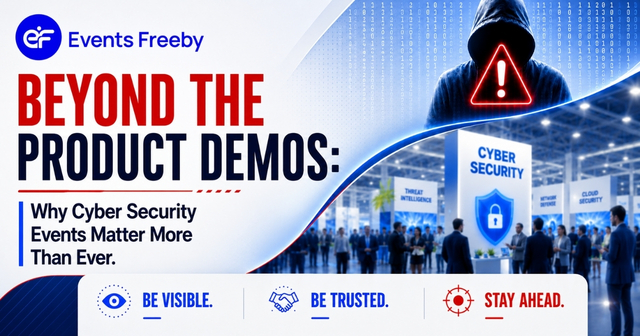
Beyond the Product Demos: Why Cyber Security Events Matter More Than Ever
Posted By: Eventsfreeby Blogger
Last Update : Jul 03, 2026



 Copied!
TL;DR
What is this blog about? This blog examines why cybersecurity trade shows, conferences, and exhibitions have become far more commercially and strategically significant in 2026 than they have ever been going well beyond product demonstrations into territory that covers intelligence sharing, B2B procurement, regulatory alignment, investor engagement, and talent scouting.
What is the size of the cybersecurity market in 2026? The global cybersecurity market is valued at USD 248.28 billion in 2026 and is projected to reach USD 699.39 billion by 2034 at a CAGR of 13.8%. Cybersecurity Ventures predicts global spending on cybersecurity products and services will exceed $520 billion annually by 2026.
What is driving the urgency? Cybercrime cost the world $10.5 trillion in 2025. AI-driven attacks have surged 89%, with attack "breakout times" dropping to 29 minutes. Over 82.6% of phishing emails are now generated using AI. The average cost of a single data breach reached $4.88 million in 2024. These statistics have turned cybersecurity from an IT department concern into a board-level commercial priority and that shift is reshaping who attends these events and why.
Why do events specifically matter? Cybersecurity VC funding exploded by 47% in the last year, reaching nearly $14 billion in total funding. Buyers are conducting complex, multi-stakeholder evaluations. Events and trade shows now consume 15–20% of cybersecurity marketing budgets, reflecting the continued dominance of face-to-face engagement in enterprise sales cycles that no digital channel can replicate.
Which cybersecurity events matter most in 2026? RSA Conference (San Francisco, March), Black Hat Asia (Singapore, April 21–24), Gartner Security & Risk Management Summit (Denver, June), Infosecurity Europe (London), GISEC Global (Dubai), and Cyber Security World Asia (Singapore) lead the global calendar.
How can Events Freeby help? Events Freeby provides end-to-end international exhibition management for B2B technology companies including cybersecurity vendors covering booth design, freight logistics, vendor coordination, on-ground execution, and pre-event outreach support across Asia, Europe, and the Middle East. Explore our services →
Introduction: The Most Important Room in Cybersecurity Isn't Online
There is something quietly ironic about an industry whose entire mission is to protect digital infrastructure being most effectively served by getting people into the same physical room.
But that is exactly where the cybersecurity industry finds itself in 2026. As the threat landscape has become simultaneously more dangerous, more AI-driven, and more commercially complex, the value of face-to-face events has not diminished. It has gone in exactly the opposite direction. The cybersecurity conference floor has evolved from a place where vendors rent space and hand out branded USB drives into something considerably more consequential: a compressed marketplace where billion-dollar procurement decisions begin, where threat intelligence gets shared faster than any report can distribute it, and where the human relationships that underpin the entire industry's trust economy get formed and tested.
Global spending on cybersecurity products and services is predicted to exceed $520 billion annually by 2026, up from $260 billion in 2021. When a market doubles in five years and when the threats driving that spending grow correspondingly more sophisticated the people responsible for evaluating, buying, and deploying security solutions need more than a landing page and a product sheet. They need to see the technology in action, speak to the engineers who built it, compare it against ten competitors in the same afternoon, and shake hands with the person they'll be calling at 2 a.m. when something goes wrong.
That is what cybersecurity events actually are. This blog is about why they matter more in 2026 than they have at any previous point in the industry's history and what companies on both sides of the aisle, buyer and seller, need to understand to make them work.
Part 1: The Threat Landscape That's Making Everyone Urgently Look for Answers
The Numbers Behind the Urgency
Before we talk about events, we need to talk about why the urgency exists. Because the commercial and strategic significance of cybersecurity conferences in 2026 is directly proportional to the severity of the threat environment driving the conversations inside them.
US losses reported to the FBI's Internet Crime Complaint Center reached $20.9 billion in 2025, a 26% jump year over year, with more than one million complaints filed the first time IC3 has crossed that threshold in its 25-year history. Globally, cybercrime damages reached $10.5 trillion annually in 2025, growing from $3 trillion in 2015 representing the greatest transfer of economic wealth in history, surpassing the damage inflicted by natural disasters in a year.
These are not abstract numbers. The global average data breach cost reached $4.88 million per incident, the highest ever recorded. Third-party involvement in breaches doubled from 15% in 2024 to 30% in 2025, according to the Verizon DBIR. Manufacturing absorbed a 61% year-over-year surge in ransomware activity.
The AI Inflection Point
The factor that is genuinely changing the conversation in 2026 in boardrooms, in procurement meetings, and on conference stages is artificial intelligence. Not as a defensive tool, though that matters enormously, but as an offensive weapon.
AI-driven attacks have surged 89%, with "breakout times" plummeting to 29 minutes. 82.6% of phishing emails are now created using AI a significant increase of 53.5% over the previous year. Nearly 9 in 10 organisations (87%) have been targeted by AI-powered cyberattacks in the last 12 months. Nearly two-thirds of managers and over half of C-suite leaders identify AI-driven attacks as their biggest challenge, warning that AI is opening new attack surfaces they are not equipped to defend.
What this creates, for the cybersecurity industry, is a procurement environment defined by genuine urgency and genuine confusion simultaneously. Decision-makers know they need to respond faster and more comprehensively than ever before. They are less certain than they have ever been about which solutions actually deliver what they promise. That gap between urgency and certainty is precisely where cybersecurity events do their most important work.
Why Digital Channels Alone Cannot Close This Gap
In most B2B technology categories, a well-built digital presence content marketing, LinkedIn outreach, webinars, paid media can move a prospect through most of the buyer journey before a human conversation becomes necessary. Cybersecurity is different, for several reasons that matter.
First, the trust dimension is uniquely high. A company evaluating a cloud ERP platform is taking a financial and operational risk. A company evaluating a security operations platform is effectively deciding who to trust with the keys to everything. That level of trust is almost impossible to establish through digital channels alone.
Second, the technical complexity is real. A CISO evaluating an endpoint detection and response platform needs to understand how it behaves against specific threat actor TTPs, how it integrates with their existing SIEM, what happens when a false positive triggers at 3 a.m., and whether the vendor's threat intelligence team has the human expertise to back up the platform's automated outputs. None of that gets adequately addressed in a marketing email.
Third, the buying committee is large and diverse. Enterprise cybersecurity purchases typically involve CISOs, CIOs, CTOs, legal and compliance teams, procurement, and sometimes board-level oversight. Getting all of those stakeholders aligned through digital interactions is exponentially harder than getting them aligned in a structured event environment where they can ask questions in real time and compare responses from multiple vendors in an afternoon.
Part 2: What Cybersecurity Events Have Actually Become
From Product Showcase to Strategic Intelligence Platform
If your mental model of a cybersecurity trade show involves a convention centre full of booths selling firewall hardware, you are working from an outdated image. The format has evolved considerably, and understanding what today's major cybersecurity events actually offer is essential context before we discuss why they matter.
Modern cybersecurity conferences operate simultaneously across several distinct functional layers:
Threat Intelligence Exchange: At events like RSA Conference and Black Hat, the most valuable conversations often happen not on the exhibit floor but in structured side sessions, closed-door roundtables, and informal hallway exchanges where practitioners share real incident intelligence that never appears in press releases. In today's threat landscape, organisations can no longer rely on a philosophy of "solo defence." The collective intelligence that flows through the community at these events often reaches practitioners faster than any formal threat intelligence feed.
B2B Procurement Environment: The major events RSA, Black Hat, GISEC, Infosecurity Europe function explicitly as B2B procurement markets. Enterprise buyers attend with evaluation checklists and budgets. The highest volume buyer events are RSA Conference, Black Hat USA, and InfoSec World, delivering booth traffic at scale, scheduled meeting density, and post-event MQL volume, with cost per lead typically in the $300 to $1,200 range when measured against full sponsorship cost.
Regulatory and Compliance Navigation: New mandates like the EU AI Act and NIS2 are forcing tighter governance, board-level accountability, and faster breach reporting. In this environment, events that bring together regulators, compliance officers, and solution providers in the same space are not optional for companies trying to navigate these requirements they are arguably the most efficient way to understand what compliance actually means in practice, rather than what it says in the regulation text.
Investor and Funding Gateway: Cybersecurity venture capital exploded by 47%, hitting nearly $14 billion in total funding. VC firms actively use the major cybersecurity conferences to evaluate portfolio additions, and founders use them to get in front of investors in a context that signals market credibility. Being absent from the key shows in your category can signal to investors that you lack the commercial confidence to compete visibly.
Talent Discovery and Recruitment: Cybersecurity faces one of the most severe talent gaps of any technical industry. Major conferences particularly community-driven events like DEF CON and Black Hat are where the most capable security researchers and practitioners can be found and recruited.
The Conference Ecosystem Has Matured Into Tiers
Understanding the tiered structure of today's cybersecurity event landscape is important for companies deciding where to allocate budget.
Tier 1 Global Flagship Events deliver the broadest reach and highest brand visibility. RSA Conference is the flagship cybersecurity event of the year. Sponsor packages run $50K to $1M+, with all-in costs including travel, staffing, hospitality, and pre-event content typically doubling the sponsorship line item. These events make sense for companies with broad market ambitions and the budget to execute at scale.
Tier 2 Regional and Vertical Events often deliver better ROI than their price tag suggests. Vertical, regional, and Tier 2 events frequently produce higher quality pipeline at 20% of the cost of Tier 1 flagships. The ROI math at vertical events is often the strongest in the entire calendar because every attendee belongs to a clearly defined buyer segment.
International Market Events open commercial access that US or European events simply cannot. GISEC, Infosecurity Europe, Black Hat Asia, and Cyber Week Tel Aviv each open distinct regional pipelines. Vendors with global ambitions need at least two international flagship events in the annual plan.
Part 3: The Must-Know Cybersecurity Events of 2026
For companies planning their event calendar whether as an exhibitor, sponsor, speaker, or strategic attendee these are the events shaping the 2026 cybersecurity calendar.
RSA Conference 2026 - San Francisco, March 23–26
RSA Conference bills itself as "Where the world talks about security." RSAC 2026's theme is 'The Power of Community.' The conference has built a whole library of live and on-demand security trainings, videos, and webinars around the main event. RSA remains the single largest gathering of cybersecurity professionals globally, drawing tens of thousands across four days. For enterprise security vendors seeking maximum buyer density, there is no larger single event.
The key programming for 2026 includes AI-driven threat integration and governance, cyber resilience frameworks, identity and access management in the zero trust era, and cybersecurity leadership reporting to boards.
Black Hat Asia 2026 - Singapore, April 21–24
Black Hat Asia returns to Marina Bay Sands in Singapore with a four-day programme featuring specialised cybersecurity Trainings for all skill levels, a Summit Day, and a two-day main conference. Black Hat Asia 2026 features Briefings by experts from around the world presenting the latest research in cybersecurity risks, developments and trends, dozens of open-source tool demos in Arsenal, a robust Business Hall, networking opportunities, and social events.
For companies with ambitions across the Asia Pacific region or companies based in APAC looking to establish regional credibility Black Hat Asia is the single most important annual event. The technical depth of its content attracts practitioners and security researchers who rarely attend commercial conferences, creating a buyer profile that is genuinely distinct from what you find at RSA.
Asia Pacific generated USD 45.28 billion in cybersecurity revenue in 2025 and is expected to reach USD 52.04 billion in 2026. A regional market of that scale, growing at double-digit rates, deserves dedicated exhibition presence and Black Hat Asia is the anchor event for that audience.
Gartner Security & Risk Management Summit 2026 - Denver, June 14–19
The Gartner Security & Risk Management Summit 2026 covers AI in Cybersecurity (securely integrating and governing AI while defending against AI-driven threats), Cyber Resilience (strengthening the ability to withstand and adapt to disruptions), and Cybersecurity Leadership, Management, and Governance. Starting at $2,950, this event attracts the most senior decision-makers in enterprise security CISOs, risk officers, and board-level advisors. The buyer quality here is exceptional, even if the volume is lower than RSA.
Infosecurity Europe 2026 - London
Infosecurity Europe is the continent's largest dedicated cybersecurity expo, drawing tens of thousands of security professionals from across the UK and Europe. Infosecurity Europe is traditionally free for qualified industry practitioners who register in advance, which drives unusually high attendance from mid-market and enterprise buyers who might otherwise skip a paid event. For vendors targeting the European market particularly those navigating NIS2 and GDPR compliance conversations Infosecurity Europe is a non-negotiable fixture.
GISEC Global - Dubai
GISEC Global has established itself as the premier cybersecurity event for the Middle East, Africa, and South Asia market. With governments across the Gulf region making significant investments in national cybersecurity infrastructure, GISEC's buyer profile now includes government procurement officers, national CERT teams, and large enterprise security departments with substantial budgets. For companies with Middle East ambitions, this show provides a concentration of buyer quality that justifies the investment.
Cyber Security World Asia - Singapore
Cyber Security World Asia in Singapore is traditionally free for qualified industry practitioners, making it one of the highest-accessibility enterprise buyer events in the APAC region. As part of Tech Week Singapore, the event draws IT security professionals, enterprise leaders, and regional channel partners from across ASEAN.
Part 4: Why the "Product Demo" Framing Has Become a Strategic Liability
Here is a truth that most cybersecurity vendors haven't fully reckoned with: if your exhibition strategy is built around demonstrating your product's features and collecting business cards, you are leaving almost all of the available value on the table.
The product demo is not the problem. Live product demonstrations remain one of the most effective ways to communicate capability in a complex technical category. The problem is when the demo is the entire strategy when everything in your booth is structured around showing what your platform can do rather than engaging with what your buyer actually needs to decide.
The Shift in Buyer Behaviour That Changes Everything
The buyers walking cybersecurity show floors in 2026 are not the same buyers who attended five years ago. The CISO role has fundamentally changed. CEOs in 2026 have shifted priorities: cyber-enabled fraud and AI vulnerabilities now rank #1 and #2 concerns, while CISOs remain focused on containment and recovery. This divergence reflects a critical gap executives worry about financial loss and emerging threats, while security teams remain focused on technical response.
This means that the buyers showing up at your booth increasingly fall into two very different categories with very different questions:
The technical buyer (security analysts, architects, SOC managers) wants to understand protocol integrations, detection logic, false positive rates, and platform architecture. They will probe your demo hard and walk away unimpressed if your booth team cannot match their technical depth.
The executive buyer (CISOs, CIOs, board members) wants to understand business risk reduction, regulatory compliance alignment, incident response support, and the commercial track record of the vendor. They are not interested in a feature walkthrough. They want to know whether they can trust your company with their most critical infrastructure.
Most booths are designed for the technical buyer. The ones generating the most qualified pipeline are designed for both with a clear structure that allows technical conversations in one space and executive-level business discussions in another, often at a private meeting table rather than an open demo station.
Intelligence as a Conversation Starter
The companies driving the highest booth engagement at cybersecurity events in 2026 are not leading with their product. They are leading with intelligence threat reports, research findings, benchmark data specific to the visitor's industry, and actionable insights about the attack vectors most likely to affect their sector.
This works for a simple reason: every CISO and security director who walks into a conference hall is already drowning in vendor communications. What they are almost never given is genuinely useful, specific, actionable intelligence about their threat environment, presented without a sales agenda attached. When you lead with that intelligence a real, credible threat briefing that is relevant to their specific industry and geography you establish a different kind of credibility than a product demo can.
Part 5: The ROI Framework - How to Measure What Actually Matters at Cybersecurity Events
There is a persistent problem in how cybersecurity companies evaluate their event performance. They measure the wrong things total booth visitors, business cards collected, branded merchandise distributed and then draw the wrong conclusions about whether the event was worth the investment.
Most ROI is determined 90 days before the event. Pre-booked meetings, speaker submissions, pre-event content, and ICP outreach drive the bulk of pipeline. Vendors who arrive with 40 to 80 pre-booked meetings consistently outperform vendors who rely on booth traffic alone.
That last sentence is worth sitting with. The companies performing best at cybersecurity events are winning before they arrive, through structured outreach, pre-booked meetings, and content strategy that positions them as thought leaders before the show floor opens.
What Genuine Event ROI Looks Like
Pipeline generation is the most important metric for a vendor investing in exhibition presence. But pipeline from events should be measured not by leads collected on the floor but by qualified opportunities that enter the sales process within 30 days of the event closing. Any lead that hasn't been followed up within 48 hours has an exponentially lower chance of converting.
Speaking slot value compounds over time in a way that booth presence alone cannot. A keynote or panel slot at a major cybersecurity event RSA, Gartner, Black Hat creates content that lives beyond the show: recordings that circulate in the community, quotes in industry coverage, and implicit analyst validation that your company's perspective is worth hearing. Speaking slots, panel placements, and keynote distribution build long-term brand equity that lead generation events cannot match.
Partner and channel development is a distinct ROI category that many vendors conflate with direct sales. Channel events those attracting MSSPs, resellers, and system integrators follow a completely different commercial logic where the relevant timeline for measuring return is six to twelve months, not thirty days.
Competitive intelligence is undervalued but real. Walking the floor at a major cybersecurity conference, attending competitor sessions, and having conversations with shared prospects gives you market intelligence that no analyst report can replicate. Understanding how your positioning lands relative to alternatives, in real conversations with real buyers, is commercially valuable even when it doesn't translate directly into closed revenue.
Part 6: The Exhibitor Strategy That Actually Converts in 2026
Every serious cybersecurity vendor knows they need event presence. The companies separating themselves from the crowd in 2026 are the ones treating event strategy as a twelve-week programme, not a three-day activity.
Twelve Weeks Out: The Foundation
The most important work happens before the show. This means:
Target account identification: Which specific companies and titles do you want to meet at this event? Map them against the attendee list (or anticipated attendee profile) and build a prioritised outreach list before anything else.
Pre-show outreach sequences: LinkedIn sequencing, personalised email campaigns, and direct introductions through shared connections are the most reliable ways to fill your meeting calendar. The goal is to arrive at the show with 80–90% of your meeting schedule already confirmed not to fill it on the fly from foot traffic.
Speaker submission (if applicable): Most major cybersecurity conferences have speaking submission windows that close three to six months before the event. If you're not already in the speaker pipeline for 2026's second-half events, add it to your planning for 2027's first-half calendar now.
Content preparation: The pre-event content you publish threat intelligence briefings, research reports, opinion pieces on emerging attack vectors builds brand presence in your buyer community before they step onto the show floor. By the time your target buyer reaches your booth, they should already know who you are.
Eight Weeks Out: Booth Design and Logistics
Cybersecurity event venues are operationally complex, and underestimating logistics is one of the most common and costly mistakes companies make when exhibiting internationally. This is especially true for events like Black Hat Asia in Singapore, GISEC in Dubai, or any event that requires shipping technical demonstration hardware across international borders.
For companies exhibiting outside their home market, freight logistics customs documentation, import regulations specific to the destination country, and freight timelines aligned with event setup windows need to be planned and confirmed at least eight weeks before the show, often longer.
Booth design for cybersecurity events follows principles that differ meaningfully from general B2B tech shows. The buyer profile is more technically sophisticated, more sceptical of marketing language, and more responsive to demonstrated credibility than to visual spectacle. What works: demonstration environments that show real threat scenarios, clear specification displays that match the technical buyer's evaluation criteria, and private meeting areas that allow executive-level conversations away from the noise of the open floor.
Our team at Events Freeby handles end-to-end exhibition management for B2B technology companies attending international cybersecurity events from booth design and fabrication to international freight forwarding, customs clearance, and on-ground logistics. If your team is planning presence at any major cybersecurity event in Asia, Europe, or the Middle East, explore how we support technology exhibitors →
48 Hours After the Show: The Follow-Up Window That Determines Everything
The single biggest failure mode in cybersecurity event marketing is what happens or doesn't happen in the 48 hours after the show floor closes.
Events and trade shows generally consume 15–20% of cybersecurity marketing budgets, reflecting the continued importance of face-to-face engagement in complex enterprise sales cycles. That is a significant budget commitment that returns nothing if the leads generated are not followed up with speed, specificity, and structure. Google News
The follow-up sequence should be designed before the show, not scrambled together after it. Every lead category (technical buyer vs. executive buyer vs. partner prospect vs. early-stage awareness) should have a distinct sequence with messaging calibrated to where that conversation ended on the floor. And the first message should go out within 48 hours ideally within 24.
Companies that execute this follow-up discipline consistently and at scale convert their show investment into pipeline. Those that don't are essentially paying conference prices for a branding exercise.
Part 7: The Specific Conversations That Only Happen at Events
There is a category of commercially valuable conversation that simply does not occur through any digital channel. Understanding what belongs in this category helps explain why the market's most sophisticated cybersecurity companies continue to increase their event spend even as their digital marketing capabilities improve.
Regulatory Navigation in Real Time
New mandates like the EU AI Act and NIS2 are forcing tighter governance, board-level accountability, and faster breach reporting. For companies selling into European markets, understanding what these mandates mean in practice rather than what they say in regulatory text requires conversations with people who are interpreting and implementing them in live enterprise environments. Those conversations happen at events, in the hallways, in roundtables, and in the sessions where actual practitioners, not lawyers drafting compliance frameworks, are discussing what these regulations mean operationally.
Zero Trust Architecture Debates
Zero trust has moved from concept to commercial requirement, but the implementation debates particularly around identity, network segmentation, and the intersection of legacy infrastructure with zero trust principles remain genuinely complex and contested. The events where these debates happen with real technical depth (Black Hat, SANS, specific Gartner tracks) are where the community's understanding of best practice gets formed and refined. Being absent from those conversations means your company's perspective on architecture doesn't influence buyer thinking.
Supply Chain Security - The Conversation Nobody Wants to Have But Everyone Needs
65% of large enterprises now cite supply chain vulnerabilities as their number one resilience challenge, up from 54% in 2025. This is one of the most commercially charged conversations in enterprise security right now because supply chain incidents have direct operational consequences that show up on balance sheets, not just in SIEM dashboards. The conferences where serious supply chain security conversations happen between practitioners who've actually experienced these incidents are where the most commercially valuable vendor relationships begin.
Part 8: What Events Freeby Does for Cybersecurity and Technology Exhibitors
We work with B2B technology companies including cybersecurity vendors, enterprise software providers, and deep tech companies managing the full operational lifecycle of international trade show participation.
The cybersecurity event calendar has become genuinely international and genuinely complex. A vendor with ambitions to establish presence in Asia Pacific, the Middle East, and Europe needs to navigate different show formats, different freight and customs environments, different booth specification requirements, and different buyer cultures across multiple events per year. Managing that operational complexity while your sales and marketing teams focus on conversations and pipeline is where we add most value.
What we manage for technology and cybersecurity exhibitors:
Booth design and fabrication that speaks to the technically sophisticated buyer profile that characterises cybersecurity events clear, credible, demo-centric, with structured space for both open floor engagement and private executive conversations.
International freight forwarding and customs clearance across major Asian, Middle Eastern, and European event markets. For cybersecurity companies shipping demonstration hardware server units, network infrastructure, security appliances understanding import regulations and freight timelines specific to each venue is critical and non-trivial.
On-ground logistics and vendor coordination, so your team's time at the show is spent on buyer conversations, not chasing setup crews or resolving logistics issues that should have been addressed weeks earlier.
Pre-event outreach campaign support and post-show lead follow-up structure, because execution quality in those two windows determines most of the commercial return from any exhibition investment.
We've supported technology companies at events across Asia, Europe, and the Middle East, and we understand what winning booth execution looks like in a competitive, technical buyer environment. If your company is planning international cybersecurity event presence in 2026 or building your 2027 calendar, get in touch with our team →
Part 9: The Future of Cybersecurity Events - What's Changing and What Isn't
What Is Changing
The format of events is evolving. The pandemic-era experiment with fully virtual conferences established that online formats can deliver content efficiently but cannot replicate the relationship formation and trust building that happen in person. The result is a hybrid format that is becoming standard: major events with strong in-person programmes that are supplemented not replaced by digital content distribution and virtual networking layers.
The buyer at cybersecurity events is changing. Companies will deploy agentic SOCs to combat AI-powered threats, and autonomous AI agents will handle up to 90% of routine triage. As AI handles more operational security tasks, the humans attending cybersecurity events will increasingly be strategic buyers evaluating platforms, vendors, and partnerships rather than technical operators evaluating specific tools. This is already changing what content formats drive the highest engagement on conference stages.
The geography of the most important events is expanding. The Asia Pacific cybersecurity market at USD 52.04 billion in 2026 is too large to treat as a secondary market. Black Hat Asia's presence in Singapore, the growth of regional events in Southeast Asia, and Singapore International Cyber Week's increasing influence all signal that the centre of gravity in the global cybersecurity event calendar is shifting eastward.
What Isn't Changing
The fundamental reason why face-to-face cybersecurity events remain irreplaceable is not going to change: trust is built between people, not between organisations. The vendor a CISO calls at 3 a.m. when their network is compromised is almost always someone they have met in person, whose technical competence they've assessed in a real conversation, and whose commercial character they've had some opportunity to observe. No digital engagement model replicates that.
The rapid evolution of the threat landscape makes physical gatherings more vital than ever. In today's threat landscape, organisations can no longer rely on a philosophy of "solo defence." The community that forms at cybersecurity events the practitioners who share real intelligence, the researchers who surface emerging vulnerabilities before they become crises, the buyers and vendors who negotiate the commercial relationships that fund defensive capability is one of the most important functioning communities in the technology industry.
Dismissing that community because your marketing dashboard shows that webinars have a lower cost per lead is a category error. The value of cybersecurity events is not captured in CPL metrics. It is captured in the deals that close six months later, the partnerships that form on the conference floor and generate revenue for years, and the threat intelligence that prevents a breach that would have cost millions.
Frequently Asked Questions - Cybersecurity Events in 2026
Q: What is the value of attending cybersecurity events for B2B companies?
Cybersecurity events provide B2B value across several dimensions simultaneously: direct buyer engagement with qualified procurement audiences, threat intelligence exchange that isn't available through any digital channel, regulatory and compliance navigation through practitioner-level conversations, investor engagement for growing vendors, and partner and channel development with MSSPs and resellers. In a category where trust is the primary commercial currency, the in-person relationships formed at these events are commercially irreplaceable.
Q: Which are the most important cybersecurity conferences in 2026?
The most significant global events are RSA Conference (San Francisco, March 23–26), Black Hat Asia (Singapore, April 21–24), Gartner Security & Risk Management Summit (Denver, June 14–19), Infosecurity Europe (London), GISEC Global (Dubai), and Cyber Security World Asia (Singapore). Regional events and vertical-focused summits often deliver stronger ROI for companies with specific buyer profile concentrations.
Q: Why do cybersecurity events matter more now than five years ago?
Three converging factors: the global cybersecurity market has roughly doubled in five years, the threat landscape has become dramatically more AI-driven and complex (requiring community-level intelligence sharing that digital channels can't replicate), and the buyer profile has shifted to include board-level executives who need to make trust-based procurement decisions in a high-stakes environment. All three factors increase the relative value of in-person events.
Q: How should a cybersecurity company measure ROI from trade show participation?
ROI measurement should focus on qualified pipeline entered into the sales process within 30 days of the event, conversion rates from event leads versus other lead sources, partner and channel relationships initiated (measured over six to twelve months), and brand equity metrics including speaking engagement and analyst citation. Business cards collected and booth visitors are leading indicators at best and meaningless at worst without structured follow-up to convert them.
Q: What is the cost of exhibiting at a major cybersecurity event?
Booth costs at Tier 1 events like RSA Conference can range from $50K to $1M+ in sponsorship alone, with total all-in costs (travel, staffing, freight, pre-event content, hospitality) typically running two to three times the sponsorship line item. Tier 2 and regional events offer sponsorship from $5K to $75K with correspondingly lower all-in costs and often stronger ROI in terms of qualified leads per dollar spent. For international events specifically, freight and logistics can add significant cost if not managed proactively.
Q: How far in advance should a company start planning for a cybersecurity trade show?
Twelve weeks minimum for domestic events; sixteen to twenty weeks for international events where freight forwarding, customs clearance, and international vendor coordination are involved. Speaker submissions for major conferences typically close three to six months before the event. Pre-event outreach sequences should launch six to eight weeks before the show to fill the meeting calendar before arrival.
Q: What makes an effective cybersecurity booth design different from other tech verticals?
The cybersecurity buyer is more technically sophisticated and more sceptical of marketing language than the average enterprise technology buyer. Effective cybersecurity booth design leads with demonstrated credibility real threat scenarios, live detection demonstrations, specific technical specifications rather than brand imagery and generic value proposition language. Private meeting space for executive conversations is as important as open demonstration areas. The booth team composition matters enormously: technical staff who can engage peer-to-peer with security architects are as important as commercial representatives.
Q: How can Events Freeby help cybersecurity companies exhibit internationally?
Events Freeby manages end-to-end international exhibition participation for B2B technology companies, including cybersecurity vendors, across Asia, Europe, and the Middle East. Services include booth design and fabrication, international freight forwarding and customs clearance, on-ground logistics and vendor coordination, and pre-event outreach campaign support. Contact our team to discuss your 2026 or 2027 event calendar →
Q: What role does AI play in shaping cybersecurity event agendas in 2026?
AI is the defining theme across virtually every major cybersecurity event in 2026 from AI-driven threat defence and agentic SOC deployment to AI governance under the EU AI Act and the offensive use of AI by cybercriminals. Events like the Gartner Security Summit, RSA, and Black Hat have all structured significant portions of their 2026 programming around the AI-security intersection, reflecting where both the threat landscape and the enterprise buying agenda have moved.
Conclusion: The Room That Cannot Be Replaced
Cybersecurity is a fundamentally human problem, even when the attack is automated, the defence is AI-assisted, and the infrastructure being protected is entirely digital. The decision to trust a vendor with your security stack, the decision to share threat intelligence with a peer organisation, the decision to partner with a channel company you've never met before all of those decisions are made by people, and they are made more reliably when the people involved have sat in the same room.
The global cybersecurity market is growing from USD 248.28 billion in 2026 to USD 699.39 billion by 2034. That growth is going to require an enormous expansion of the commercial infrastructure that connects buyers with solutions: more events, better events, more specialised events calibrated to specific buyer segments and geographies.
The companies that treat those events as a necessary cost are going to find themselves outcompeted by the companies that treat them as a strategic investment one that requires proper planning, proper execution, and proper follow-up to deliver the returns it's capable of generating.
The product demo, at the end of the day, is just the opening act. What happens in the conversation before it, around it, and after it is where the real commercial value of a cybersecurity event lives.
If your company is planning exhibition presence at a cybersecurity event in Asia, Europe, or the Middle East and wants an experienced partner to handle the logistics while your team focuses on the conversations, our team at Events Freeby is ready to help →
Published on Jul 03, 2026