
 Home
HomeHome / Stop Counting Business Cards: The New Metrics for Event ROI in AdTech
Stop Counting Business Cards: The New Metrics for Event ROI in AdTech
Posted By: Eventsfreeby Blogger
Last Update : May 20, 2026



 Copied!
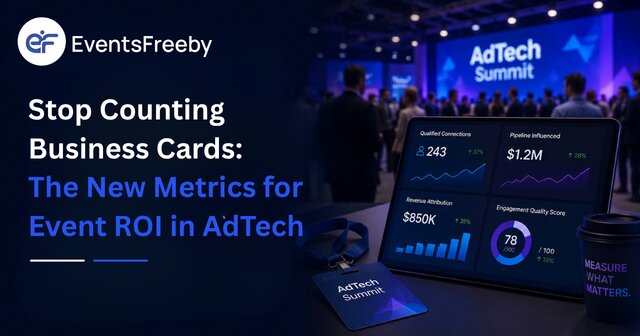
The AdTech industry has been measuring event ROI wrong for years. Business cards collected, booth visitors counted, and LinkedIn connections made are activity metrics — they measure motion, not momentum. This blog introduces the new framework for measuring event ROI in AdTech: one that tracks pipeline velocity, partner activation rate, share of voice, content amplification, post-event revenue attribution, and brand recall signals. It also covers how to build a pre-event baseline, what to measure during the event itself, and how to structure the 30-day post-event measurement window that most companies completely ignore. If you're an AdTech company — whether you're a DSP, SSP, MMP, ad network, or mobile-first brand — and you've ever come home from a global expo unsure whether it was worth it, this blog will change how you think about event investment entirely.
The Business Card Problem
Picture a Monday morning debrief, three days after a major AdTech summit.
The team is back in the office — or on a Zoom call, jets still lagged, voices still slightly hoarse from three days of expo-floor conversation. Someone pulls up a spreadsheet. There are 340 business cards scanned into the CRM. The booth had an estimated 600 visitors over two days. Seventeen people signed up for a product demo. The team collectively spent eleven days travelling and attending, plus the cost of the booth, the flights, the hotel, and the branded merchandise.
And then someone asks the question that nobody has a clean answer to: "So — was it worth it?"
The silence that follows is not because the event was bad. It's because the company is trying to answer a strategy question with activity data. And activity data — business cards, booth visitors, demo signups — tells you almost nothing about whether an event created real commercial value.
This is the business card problem. And it is endemic across the AdTech industry.
The companies that consistently extract disproportionate value from global events — the MMPs that walk away with three new integration partnerships, the DSPs that close enterprise clients they've been chasing for months, the ad networks that double their regional pipeline in 48 hours — these companies don't measure events the way everyone else does. They've built a different framework. A more honest one.
Here's what it looks like.
Why the Old Metrics Are Lying to You
Before we build the new framework, it's worth being precise about why the old one fails.
The traditional event ROI metrics — leads collected, business cards scanned, booth traffic, demo requests — share a common flaw: they measure the beginning of a relationship, not the quality or trajectory of it. They capture the moment of contact, not the moment of value.
In AdTech specifically, this creates a distorted picture because the sales cycle is long, the relationships are complex, and the actual decisions — which MMP to use, which DSP to partner with, which ad network to prioritise budget toward — are rarely made on the expo floor. They are made weeks or months later, in boardrooms and procurement meetings and product review sessions, by people who may not have even been the ones staffing the booth conversation.
So when a company counts 340 business cards and declares an event successful, what they've actually measured is the number of times two people stood close enough to each other to exchange contact information. That is not ROI. That is footfall data dressed up as strategy.
The other problem with old metrics is that they create perverse incentives. When teams are measured on leads collected, they optimise for volume over quality. Badge scanners come out for every casual conversation. The CRM fills up with contacts who barely remember the interaction. The follow-up sequence goes out to 340 people and converts 2. And somehow the event is declared a moderate success because "we generated 340 leads."
There is a better way. And it starts with a different question.
The Right Question to Ask About Event ROI
Instead of "how many leads did we generate?" the question that unlocks genuine event ROI measurement is this:
What specific, measurable things changed as a result of our presence at this event — and what is the commercial value of those changes?
This question forces precision. It separates activity from outcome. And it opens the door to a measurement framework that actually reflects the multi-dimensional value that global events create for AdTech companies.
Because events don't create value in a single dimension. They create value across at least six distinct categories simultaneously — and measuring only one of them (leads) means you're missing the other five.
Here's how to measure all six.
Metric 1: Pipeline Velocity — Not Volume
Pipeline velocity is the measure of how fast qualified opportunities move through your sales cycle. It's a function of the number of qualified deals in your pipeline, the average deal value, your win rate, and the length of your sales cycle.
Events affect pipeline velocity in a specific and measurable way: they compress the trust-building phase of the sales cycle. A conversation that would take six email exchanges and two Zoom calls to achieve in a remote environment takes fifteen minutes face-to-face. That compression has a real commercial value — and it's measurable.
Here's how to track it: identify the deals in your pipeline that had a meaningful touchpoint at the event — whether that was a first conversation, a relationship deepening, or a specific commitment made. Then track those deals separately and compare their velocity to deals that entered your pipeline through non-event channels in the same period.
In most AdTech companies that do this analysis honestly, the event-touched pipeline moves 30 to 50 percent faster than non-event pipeline. That acceleration has a dollar value. Calculate it, and suddenly the event ROI conversation looks very different.
This is also why Events Freeby focuses on end-to-end event participation execution rather than just logistics — because the quality of execution on the ground directly affects the quality of the conversations that drive pipeline velocity.
Metric 2: Partner Activation Rate
In AdTech, partnerships are often more valuable than direct sales. An integration between an MMP and a DSP, a data-sharing arrangement between an ad network and a clean room provider, a preferred partner status between a mobile measurement company and a major publisher — these relationships generate compounding revenue that direct sales rarely match.
Events are the primary venue where these partnerships initiate or accelerate. And yet almost no AdTech company measures what happens to the partnerships that begin at events.
Partner activation rate is simple: of the partnership conversations that began or meaningfully advanced at an event, what percentage resulted in a signed agreement, a live integration, or a formal commercial relationship within 90 days?
Tracking this metric across multiple events gives you something genuinely useful: a comparative view of which events produce the highest-quality partnership conversations for your specific business. Some events will have high badge scan numbers and low partner activation. Others will have modest attendance but exceptional partner activation. That data should be driving your event calendar — not the prestige of the event name or the size of the expo floor.
Browse the full AdTech events calendar on Events Freeby with this metric in mind — and start evaluating events by the density of your target partnership profiles in attendance, not just by overall attendee numbers.
Metric 3: Share of Voice — During and After the Event
Share of voice is a marketing metric that measures your brand's presence in a conversation relative to your competitors. At events, it has two dimensions: on-ground share of voice and digital share of voice.
On-ground share of voice is harder to quantify precisely but straightforward to estimate. It's a function of your booth position, your speaking presence, your team's activity on the floor, and the quality of the experiences and moments you create. Did your brand come up in conversations you weren't part of? Did other exhibitors reference you? Did attendees seek out your booth specifically rather than stumbling across it?
Digital share of voice during and immediately after an event is precisely measurable. Track mentions of your brand name and your key spokespeople across LinkedIn, X (Twitter), and industry publications in the 72-hour window around the event. Compare this to your share of voice in the 72 hours before the event. The delta is your event-generated share of voice lift.
Compare this lift to your competitors' lift during the same period. This tells you, with reasonable precision, whether your event presence is moving the needle on market perception — or whether you're spending significant budget to maintain a static position while others gain ground.
For Indian AdTech companies specifically, this metric is particularly revealing because the baseline share of voice in global markets tends to be low. Even a modest, well-executed event presence can produce a measurable and significant share of voice lift — which compounds into brand recall over subsequent events.
Metric 4: Content Amplification Coefficient
Every global AdTech event produces content — keynote recordings, panel summaries, attendee posts, photographer galleries, journalist roundups. Your brand's presence in that content ecosystem is a measurable and meaningful indicator of event ROI.
The content amplification coefficient is a composite measure: how many pieces of third-party content referenced, featured, or quoted your brand in connection with the event? How many people shared or engaged with content you produced during or immediately after the event? And — crucially — what was the total reach of that content?
This metric matters for a specific reason: content generated around events has a longevity that the event itself does not. A well-placed quote in an industry roundup, a LinkedIn post that generates 500 comments, a panel recording that gets embedded in three trade publication articles — these assets continue generating brand awareness and recall for weeks or months after the event floor has been cleared.
AdTech companies that understand this build content production into their event strategy from the beginning. They bring a dedicated content team member to the event. They have a post-event publication plan ready before they land. They brief industry journalists ahead of the summit. And then they measure the amplification that results.
This is not a vanity metric. Content amplification has a directly calculable media value — what it would have cost to generate equivalent reach through paid channels. For most well-executed event content strategies, this value alone covers a meaningful portion of the total event spend.
Metric 5: Post-Event Revenue Attribution
This is the metric that finance teams actually care about — and the one that most event marketers are least equipped to measure cleanly.
Post-event revenue attribution asks: of the revenue our company generated in the 90 to 180 days following this event, how much can be traced back to a relationship, conversation, or commitment that originated or advanced at the event?
Clean attribution here is genuinely difficult. Sales cycles in AdTech are long and multi-touch. The conversation at a Bangkok summit might be the fifth touchpoint in an 18-month relationship, not the first. Attributing revenue entirely to any single event would be as misleading as attributing it to none.
The right approach is influence attribution rather than hard attribution. Flag every deal in your CRM that had a meaningful event touchpoint — first meeting, significant relationship advancement, commitment to a next step — and track those deals through to close. When they close, note the event influence in your revenue data.
Over time — across four, six, eight events — this data builds a picture of which events produce the highest-influence pipeline. Not the most leads. The most revenue influence. That is the number that should be driving your event budget allocation.
Metric 6: Brand Recall Signal Strength
Brand recall is the hardest of the six metrics to measure — but it's arguably the most important, because it's the foundation on which everything else is built. You cannot accelerate pipeline, activate partners, or generate content amplification if people don't remember who you are.
Brand recall signal strength is measured indirectly, through a combination of indicators:
Inbound mention rate. In the 30 days after an event, how many times does your brand get mentioned, tagged, or referenced in content produced by people who were at the event? This is a proxy for how memorable your presence was.
Search volume lift. In the two weeks after a major event, is there a measurable uptick in branded search queries for your company? Tools like Google Search Console and Google Trends can surface this signal with reasonable precision.
Direct outreach rate. How many people reach out to your team proactively — via LinkedIn, email, or your website contact form — in the 30 days after an event, referencing the event as the reason for their contact? Inbound beats outbound on almost every quality metric, and events that generate genuine inbound are events that generated genuine recall.
Re-engagement rate from past contacts. Did any dormant contacts — people in your CRM who had gone quiet — re-engage in the post-event period, referencing the event as the trigger? This is one of the clearest signals that your event presence reached beyond the people you physically met.
Track these signals consistently and you'll start to see which events produce genuine recall and which produce only temporary visibility.
Building the Measurement Infrastructure Before You Arrive
None of these metrics work unless you build the measurement infrastructure before the event — not after.
This is where most AdTech companies fail. They attend the event, come home, and then try to measure ROI retrospectively with incomplete data. The result is always the same: inconclusive analysis, vague conclusions, and a budget conversation that comes down to gut feel rather than evidence.
The pre-event measurement checklist looks like this:
Tag every target account in your CRM that you plan to engage at the event. Create an event-specific tag or campaign so you can filter your pipeline by event influence later.
Establish your share of voice baseline before the event. Run a two-week social listening window before you land, capturing your brand mention volume on LinkedIn and X. This is your baseline against which you'll measure post-event lift.
Set your pipeline velocity baseline. What is the average time-to-close for deals in your current pipeline? You'll compare event-touched deals against this baseline to calculate velocity impact.
Brief your team on conversation logging. Every significant conversation at the event should be documented — ideally in real time, via a voice note or a shared team doc — with enough detail to make the follow-up meaningful and the CRM tagging accurate.
Define your 30-day post-event measurement window before you leave. Decide now what you will measure, how, and who owns the analysis. If you wait until you're back in the office, the data discipline disappears into the post-event hangover.
The Events Freeby process is built around exactly this kind of structured preparation — because the difference between an event that generates measurable ROI and one that generates a vague sense of value almost always comes down to the work done before the first flight is booked.
The 30-Day Post-Event Window — And Why Most Companies Waste It
The 30 days after a major AdTech event are, commercially speaking, the most valuable 30 days in your event ROI cycle. This is when the relationships formed on the expo floor are still warm, the conversations are still fresh, and the window for converting activity into outcome is still open.
Most companies waste this window in two specific ways.
The first is the generic follow-up email — the one that could have been written before the event, that references nothing specific about the conversation that was had, and that asks for a next step so vague ("would love to chat further") that it creates no urgency and no clear reason to respond. This email does not advance relationships. It archives them.
The second waste is the debrief that doesn't debrief. The team gets back together, shares highlights, agrees that it was "a good event," and then disperses back into their normal workflows. No structured analysis, no metric review, no decision about what to do differently next time. The institutional learning that should compound across events simply evaporates.
The AdTech companies that consistently generate positive event ROI run a different 30-day playbook:
Within 72 hours — personalised, specific follow-up to every significant conversation. References something real. Delivers something of value. Proposes one concrete next step.
Within two weeks — a first-pass metric review against the six measures outlined above. Enough time has passed to see early signals; not so much time that the data is stale.
Within 30 days — a formal post-event debrief that produces a written decision: what we're doing differently at the next event, which relationships we're prioritising, and what the preliminary revenue influence picture looks like.
This discipline is what separates the companies that get better at events over time from the ones that repeat the same expensive experiment and wonder why the results don't improve.
The Framework in Summary
To make this concrete and actionable, here is the full measurement framework in one place:
Before the event — establish baselines for share of voice, pipeline velocity, and branded search volume. Tag target accounts. Brief the team on conversation logging.
During the event — document conversations in real time. Track speaking moments, partnership commitments, and significant relationship advancements. Note every moment that could become a content asset.
Within 72 hours after — send specific, personalised follow-up. Begin tagging CRM records with event influence.
Within 30 days — measure pipeline velocity for event-touched deals. Calculate share of voice lift. Review content amplification. Count partner activation conversations advanced. Track inbound mention rate and direct outreach.
Within 90 days — assess partner activation rate. Begin building the revenue influence picture. Compare all metrics against the baseline and against previous events.
Within 180 days — finalise revenue attribution analysis. Make budget allocation decisions for the next event cycle based on evidence, not assumption.
This is not a complex framework. It's a disciplined one. And discipline, applied consistently across a multi-event strategy, is what transforms events from a cost centre into a compounding growth lever.
The Bigger Picture
The AdTech industry is built on measurement. Attribution, incrementality, viewability, fraud detection — the entire ecosystem exists to bring rigour and accountability to marketing spend. And yet, somehow, the industry's own marketing activities — its event participation, its trade show presence, its global conference strategy — have been allowed to operate in a pre-measurement era, judged by metrics that would be laughed out of any performance marketing conversation.
That is changing. The companies that are leading this change — the MMPs, the DSPs, the ad networks, and the mobile-first brands that are building genuine event ROI measurement frameworks — are extracting dramatically more value from the same event calendar that their competitors are attending and undervaluing.
The business card is not useless. It's just not a metric.
Everything else in this blog is.
Ready to Make Your Next Event Count?
At Events Freeby, we help AdTech companies and global businesses participate in international events with the strategic rigour that the investment deserves. From identifying the right events for your specific audience and goals to managing end-to-end booth execution and post-event follow-through, we handle the operational complexity so your team can focus on the conversations and the metrics that matter.
Explore upcoming AdTech events globally, understand how our participation process works, or reach out to our team to start building an event strategy that you can actually measure.
Stop counting business cards. Start counting what counts.
Published on May 19, 2026